De Franse neurowetenschapper Arnaud Delorme deed een onderzoek naar de mogelijkheid om aan iemands foto te kunnen zien of die persoon nog leeft of reeds is overleden. Zijn resultaten publiceerde hij in april dit jaar in het open access journal Frontiers in Human Neuroscience. Het onderzoek wees uit dat de deelnemers het iets beter deden dan je zou verwachten als de keuzes louter toevallig zouden zijn (53,8 procent). Het artikel is nu echter ingetrokken.
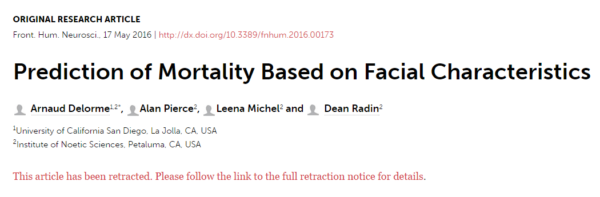
Delorme is als neurowetenschapper verbonden aan een aantal universiteiten in Frankrijk en de Verenigde Staten, maar klust blijkbaar ook bij als parapsychologisch onderzoeker aan het Institute of Noetic Sciences. Dean Radin, de laatste genoemde auteur van het artikel (‘Prediction of Mortality Based on Facial Characteristics‘), is een bekende parapsycholoog, die nogal stevig bekritiseerd is door skeptici als Chris French en Ray Hyman.
In het onderzoek werden twaalf mediums op de proef gesteld. Ze kregen ruim 400 portretfoto’s voorgeschoteld afkomstig van jaarboeken van verschillende periodes, maar ook recentere foto’s van voornamelijk politici en zakenmensen uit een andere staat (niet Californië, waar de mediums vandaan kwamen).
Participants were asked to press a button if they thought the person in a photo was living or deceased. Overall mean accuracy on this task was 53.8%, where 50% was expected by chance (p < 0.004, two-tail). Statistically significant accuracy was independently obtained in 5 of the 12 participants.
Op zich lijkt dit onderzoek helemaal niet zo slecht opgezet, maar in het oog springt dat er helemaal geen controlegroep was. Je weet dus helemaal niet of die 53,8 procent nu echt bijzonder is. De verwachte 50 procent is gebaseerd op het gegeven dat de deelnemers evenveel foto’s van nog levenden als overledenen te zien kregen. De onderzoekers hebben wel hun best gedaan om er voor te zorgen dat die verzamelingen met foto’s van levenden en overledenen niet van elkaar afwijken op allerlei visuele kenmerken, maar een vrij voor hand liggende laatste controle met proefpersonen die zichzelf niet als helderziend beschouwen, hebben ze nagelaten. Wellicht zijn er daarom toch subtiele verschillen tussen de personen op de foto’s die zouden kunnen duiden op een verschil in gezondheid dat je misschien onbewust zou kunnen oppikken. Ook het gegeven dat vooral bij de recentere foto’s ‘positieve’ resultaten werden geboekt, geeft te denken.
Wat de editors van Frontiers in Human Neuroscience nu precies heeft bewogen om het artikel in te trekken is niet zo duidelijk. Ze geven alleen de volgende verklaring:
Following publication, concerns were raised regarding the scientific validity of the article. The Chief Editors subsequently concluded that aspects of the paper’s findings and assertions were not sufficiently matched by the level of verifiable evidence presented.
De auteurs zijn het helemaal niet eens met de intrekking. Delorme laat in een reactie op Retraction Watch ook weten het ontbreken van de controlegroep helemaal niet relevant is, omdat ze alleen onderzochten of een groep ‘beter’ zou kunnen scoren dan een verwachte 50 procent – niet of ze beter zouden scoren dan een controlegroep. Op zich staat dat ook in het artikel en in de Discussion wordt ook wel enige voorzichtigheid betracht bij het duiden van het resultaat:
… an adequate explanation may rest upon subtle clues that might have been unconsciously exploited. Of interest in this regard is that post-session interviews with the participants indicated that they sometimes “felt” a difference between images of deceased vs. living individuals, which was consistent with their claims. However, overall their accuracy levels were only modestly above chance, so that feeling was apparently not as accurate as they may have thought. Regarding alleged claims of clairvoyance by the tested subjects, our data does not allow for a rigorous test of that hypothesis, but it is certainly compatible with it. Our data does warrant further investigation of that hypothesis.
Maar die laatste zinnen maken stiekem toch duidelijk dat de onderzoekers wel wat zien in die hypothese en bereid zijn om de misschien niet eens significante resultaten van dit onderzoek op te rekken tot een ondersteuning daarvan.
Dat het helemaal niet makkelijk is om een goede set foto’s voor een dergelijk onderzoek samen te stellen, weten ze bij de werkgroep Utrecht van Skepsis ook. Iemand had zich gemeld bij Skepsis omdat hij zijn gave wel eens op de proef gesteld wilde zien. Hij zou op basis van een foto met een pendel kunnen vaststellen of de persoon of de foto overleden is of nog leeft. De proef wees uit dat het wel meeviel met die gave.
Lees verder bij: